About this Blog

This is the Blog of Live Project 11 - Shelter Library, a live project undertaken during autumn 2008 by MArch Students from Sheffield School of Architecture.

Shelter Library is the key information resource for the humanitarian shelter sector. Shelter Centre the client for this Live Project are an International NGO based in Geneva. They work to support communities impacted by conflicts and natural disasters by serving collaboration and consensus in the humanitarian shelter sector.

Our project wrapped in late November 2008 the work of shelter centre continues however as does the Live Project Programme at SSoA, for further information please follow the links.

We hope you enjoy, play safe now

27 Oct 2008

Tools for Sourcing

Since paths, interaction and transfer over the internet work rhizomically, attempting to source a bulk of content on a specific topic becomes increasingly difficult and myriad. The more content is searched and stored, the narrower the field becomes in which to discover useful information. Converse to this logic, the more data that is amassed, the more routes and opportunities for fresh information open up. To ensure website hits are documented, logged and not revisited by other team members, a number of plug-in tools have been implemented to systematize the content sourcing stage of the project.

StumbleUpon
creates a record of the path taken through an internet search, enabling logging and categorisation of websites. Websites are listed on a home page and accessible for all users to see and add to. Furthermore, a plug-in tool enables new websites to be ‘stumbled upon.’ These are recommended by other users, cross referenced with appropriate tags and sourced from the existing bank of websites so are different and relevant. This not only enables a documentation of the content sourcing procedure but is also a way to hit upon fresh content that may be of use.

GoogleDocs
is a shared spreadsheet document system that can be accessed by all users and updated live. Sources of content are split into two categories here; those that have been searched through and those that are yet to be looked at. Users can see who else is online and can communicate through a chat facility. Documents can therefore be sourced more efficiently as it is obvious which avenues have already been explored and which need immediate attention.


VOLUNTEER FROM HOME

The Live Project Team has been working towards a target of 500 new entries to considerably expand the existing Shelter Library. However this is by no means a finite quantity and a serious concern for the Live Project Team has been how the library can be expanded and maintained after our input, particularly considering the nature of the information and its reliance on up-to-date information and new technologies.

For this reason the team has been working on creating a Standard Operating Procedure (SOP) that enables future Shelter interns to easily maintain the library, drastically reducing the ‘floundering’ period of the research. However, the Shelter Centre is a small organisation, largely comprised of interns on short placements and properly maintaining the library would require a significant commitment from the Shelter Centre.

The Live Project Team believe that there is a potential resource of willing volunteers that can be utilised by Shelter Centre. In a sector where volunteering information exchange is as important or more important than volunteering physical presence, we believe that our SOP could be used remotely enabling people to volunteer time from locations all over the world. In the past Shelter Centre has tended to disregard using volunteers without extensive experience within the humanitarian sector. However, a detailed SOP to manage volunteers, fully tried and tested, offers people with limited prior knowledge the opportunity to contribute, by following a step by step procedure.

…Humanitarianism

A benefit to the group from the Geneva visit was an explanation by shelter centre of some of the organisational and professional structures which make up the humanitarian sector. From the uniformed position of interested outsiders the sphere of humitarianism was perceived as more of a volunteer based ad-hoc network rather than the muti-billion dollar professional industry which it is in reality.

Sector Organisation

Simplified, the sectors major players are divided into three groups:
UN – various agencies mandated to avoid overlap and gaps [sic] most of these agencies act in a coordination and policy making role. They aim primarily to organise the operational activities of NGO’s
NGO’s – a raft of actors from the large international organisations, IFRM
Donors – Government agencies and charitable foundations who provide financial material and human resources to the Humanitarian Sector

Humanitarian sector reform
Led by the Inter Agency Standing Committee (IASC) and coordinated through the website www.humanitarianinfo.org, reform of the humanitarian sector is being directed towards workgroup clusters rather than seperarte overlapping organiseations. These clusters subdivide the Humanitarian sector into different relief areas with the intention of coordinating the actions of separate NGO’s working in the same operational theatre. This process manifests in Humanitarian Information Centres (HIC’s) which the IASC instigates for each distaster the Humanitarian sector intervenes in.

Professional organisation

CPD -The workforce in the humanitarian sector is arranged into professional disciplines not dissimilar to the strands into which professionals in the construction industry are separated into. Humanitarian professionals have training goals which must be achieved prior to promotion to the higher levels of the sector – namely field operations. Involvement in field operation is restricted to individuals who have proven experience in humanitarian operations or sufficient training and understanding: NGO’s are highly risk averse with regards new operatives. It is precisely for the facilitation of this training, or Capacity Building, within the Humanitarian Shelter Sector that the Sector Training component of the Shelter Centre website was conceived.

23 Oct 2008

Research Methods and Structure

Beta post … for comment & revision

It is apparent that a proper management structure is paramount for this project and needs to go beyond simple task allocation. This structure requires flexibility to accommodate tasks with indeterminate time lengths and potential overlaps. Since the content sourcing may become drawn-out and monotonous, the management arrangement must also include tactics to guard against a drop in productivity. In recognition of this and in dialogue with Shelter Centre, the content sourcing process will be arranged thematically and kept on a tight leash with regards to time and resources. This aims to not only streamline the sourcing process and target quality entries more effectively, but also hopes to sustain high productivity and continual interest for the LP team.
Furthermore in order to coordinate the delivery of a useful end-product [for the shelter centre library] the sourcing of useful content needs to be programmed in parallel with components such as documentation, project inheritance and the development of a standard operating procedure. The team’s ‘project champion’ has the responsibility of coordinating the upcoming intensive content sourcing week. Feedback from Shelter Centre prior to project closure must be facilitated and so ensuring further space for project development.

22 Oct 2008

Charting project components

After our initial meetings with Tom Corsellis, an increasing clarity to the component parts of the project was drawn up. A charting of our project deliverables was established, ranging from client base requirements to further project potential. The project components are chronologically ordered; ranging from original brief deliverables (see numbers 1, 2 et cetera of the project map) to our own particular aspirations for the Shelter Library with regards to content sourcing and the future implementation of this. The upper numbers represent more ambitious aims: for example areas of project inheritance that could possibly be implemented in future live projects or during future collaborations between Shelter Centre and student groups.

La Nuit Fondue


The team - willing and keen to experience the entire strata of humanitarian aid culture within the capital of the humanitarian aid world - dutifully partook in a taster of the local delicassey. Fondue, a rather 'open source' process of cheese consumption, brought the team together with various members of the Shelter Centre group in order to help develop the communication, discuss strategy and knock back a couple of pints of molten swiss cheese.

21 Oct 2008

Team in Geneva!

Since arriving in Geneva on Monday evening, we have taken over a small area of the Shelter office. Aside from a visit to the Red Cross Museum and a taste of Geneva’s best fondue, we have spent the majority of our time working alongside Shelter conceptualizing our approach to the project. Being in direct contact with Tom Corsellis has enabled us to clarify our collective aims for the remainder of the project.
Sourcing relevant content for the Shelter Library has become one of our main priorities, whilst evaluating and documenting our processes. Being in Geneva and conversing with Tom has made us aware of an additional number of sources of information for the library, including the world’s current largest ‘physical’ shelter library (which comprises just three bookshelves in Tom’s office!) On this realisation, the broader significance of the project has dawned upon us. A major inefficiency in the humanitarian sector is lack of continuity between missions. Our effort is to create a memory for humanitarian shelter that can be used time and time again by the workers in the field.

18 Oct 2008

Live Project Report

The following report was prepared and issued to Shelter Centre for confirmation re. the objectives of the brief and to develop a better understanding of how we might best be able to respond to the brief in terms of establishing longevity to the Shelter Library project.


14 Oct 2008

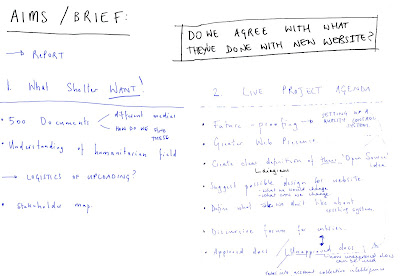
Last Thursday's meeting - what the client requires vs/and/or what we will provide


These are some of the notes that were made during the meeting. Shelter Centre's new website was launched [ http://www.sheltercentre.org/library ] last week and gave us the opportunity to analyse the 'pros' and 'cons' of the new online library service. More on these to come...


12 Oct 2008

Calling Geneva!

Been looking and trains from Geneva to Venice are actually cheaper when you get them through the Swiss train people..... http://www.sbb.ch/en/index.htm We can get them when we get to Geneva.

10 Oct 2008

Post Conference Meeting

Laura emailed us after the conference meeting and included some links. I have copied and pasted her e-mail here
"Hello everyone,
It was good to hear from you all before, I hope that you found the briefing useful and that you're looking forward to project getting under way.The new website has changed to a new address at
http://beta.sheltercentre.org, it will be there until the 9th of October after which it will be officially launched and will move to http://www.sheltercentre.org ...
Please find attached two documents containing publications that were found for Shelter Centre by an external consultant, these should give you some ideas of the direction to aim for. [see Shelter Library One Five Samples] Also, http://www2.hdm.lth.se/bi/report/frame.htm is a link to a number of appropriate publications at Lund University, Sweden. I will get back to you soon regarding the best way for you to input the publication data, and which fields of information will be requires.
Looking forward to working with you all,
Laura"

Conference Meeting with client #1


Tom briefs the group from Geneva over an online conference.

We had a live briefing session over Skype with Tom C and Laura H who were based in Geneva on Friday 3rd October. It was a very successful conference meeting in that Tom C communicated clearly to the group and was concise with his speech. When is come to contacts with clients, the effectiveness of the methods of communication is very important.


Below is a summary of the meeting but the whole 45 minutes-long conference session transcribed by Laura Collins is available. [see Conference Call pdf]


Shelter Centre is a new flavour of NGO - it’s a sector support NGO – and this means that it is not actively operational but in the background helping a range of aid agencies to address humanitarian shelter with operational guidelines, community practice tools, resources of meetings and training.

All of Shelter Centre’s work is open source, all the work is ‘share-wear’ so to speak which is a somewhat new approach unlike many other organisations who publish their own brand.

It is important to realise that the state of the Humanitarian Shelter Sector is far behind the state of other sectors of humanitarian response. These sectors are like departments for example the sanitation sector, logistics, health, nutrition.

Shelter Centre has been framework funded by DFID, the Department for International Development of the British Government over 5 years.

http://www.dfid.gov.uk/

There are two Shelter Meetings held each year, on in Geneva and the other in Brussels. At these meetings are representatives from all the major UN agencies, NGOs, IOs and donors as well as academics to discuss how to prioritise and progress activities for the collected Shelter Sector of response. Participation is free.

One of the main delivery tools of Shelter Centre is the website which is intended as an everyday of the week continuation of the Shelter Meeting.

Consequently the internet is wonderful as a resource for the aid business but to date we had websites which either tried to sell you a goat to get funding or they try to push information. The sort of face-book, discursive resources really are not there and we feel this is a great shame, a missed opportunity and

Shelter Centre has developed one of the first web 2.0 websites for the humanitarian community which is going live on the 10th October 2008. This has been developed by one of the leading open source software developers in DRUPAL, an organisation called Development Seed. Another organisation from the birthplace of DRUPAL is the open source content management system based in Brussels called Crimson.

The main aim of the website is to provide reference material for aid agencies that require information out on the field. These include technical guidelines, reports and case studies. The website will also be used to pin-point and connect different aid workers located in the same areas.


Some other resources: (provided by Foxwell)
The Martin Centre in Cambridge (research into disaster relief and development)ITGD –
http://www.practicalaction.org/


Matthew’s book – appropriate building methods or similar bibliography.

Group Meeting #1 (Tuesday 30th September 2008)

On Tuesday 30th September, the individual members of the team had an introductory meeting to become acquainted with each other. Through the meeting, the aim of this live project was concluded to be to develop the library information foundation of Shelter Library: the Global Resource for Humanitarian Community’s existing work. Shelter Library serves as a source for the humanitarian sector.

As this was the first meeting, it was not surprising that all team members raised questions as to the objectives of the project and tried to clarify the brief. The client has not specified any definite brief based on the information we had at this stage of the project. However it may seem that the client has expectations from the project group in terms of contributing to the contents of the online resource centre. [see Brief for the University of Sheffield Department of Architecture ‘Live Project 2008’]

Some of the questions raised and thoughts for debate at that stage were as below:

  • What is the best way to communicate with the client and to run this project?
  • Where will our work go beyond the tagging and entering of data?
  • How can we introduce the availability of technologies/mobile technologies?
  • How could training be integrated?
  • How can we find funding but not waste time fundraising?
  • How can we ensure that the online library is geared towards agencies as represented by Shelter Centre? And ensure that this does not become a branding exercise?
  • How can we test our strategies /presentations before making them open to the public?

Communication with the Client

It was reassuring to know that Tom C would be available for a conference meeting on 3rd October. The fact that the client is based in Geneva, Switzerland means face-to-face communication is limited. But we the team has agreed to take a trip to Geneva for the chance to meet the client and to vary the method of communication with the client. At this moment in time, emails are being used as the main form of contacting the client and for sharing information.

Perhaps we were starting at the deep end with these thoughts and needed to focus on our planning and agenda for the entire project. [see minutes 30.09.08]

9 Oct 2008

How did the University of Sheffield meet Shelter Centre???

Renata invited Pete Manfield to run a workshop and a lecture at the school 4 years ago about 'Shelter' for the Whole School Event (the theme was 'whatever the WEATHER...) Pete Manfield and Tom Corsellis used to work together on Sheffield Centre in Cambridge. She met Tom earlier this summer and through talks about our Live Projects here at Sheffield. Tom made references to last year’s URINE project http://www.01liveproject07.wordpress.com. This led to a possibility of submitting a proposal and hold and behold Shelter Centre was selected as live project number eleven, chosen from a short list of 20 by staff at the department. This concept of Live Project is very different to past and current running live projects.

It was an “unknown territory and different dimension to the others” as Renata describes it. Shelter Centre did not know for sure that the proposal will be selected so at the start of the project (at this stage), we can interpret the brief to suit us but we should have consultations with the client in order to keep the point of the project in focus. We should strongly consider negotiating with the client what the objectives of the project are and also and challenge the original brief.

About the Team Members

Cathrine Allison
6th Year Architecture Student at Sheffield University (M.Arch); Graduate from Oxford Brookes (RIBA Part 1) and ETSAB exchange (Barcelona).
Most of my work experience has been conservation, residential and green-eco-type visitor centres in Scotland. I have also participated in and fund-raised for a recent Voluntary Design and Build Project in Romania.


Laura Cinnamond Collins
5th Year Architecture Student at Sheffield University (M.Arch); Graduate from the Mackintosh School of Architecture, Glasgow School of Art (RIBA Part 1)
I have undertaken work placements in practices in Belfast (Todd Architects, Hamilton Architects, Hall Black and Douglas Architects), Belgrade (MIT Arcitects) and Paris (Edouard Francois, Jean Nouvel) across a range of private and public sector projects. My interest in the development sector and the work by Shelter Centre stems from my volunteer work with School Aid Romania and Asha India during my school years, and current volunteer work for Article 25.


Sarah Considine
6th year Architecture Student at Sheffield University (MArch); Graduate from Sheffield University (RIBA Part 1).
I have two years work experience prodominately in working in the housing, community and education sectors, on both small-scale, self-run and large-scale, team-orientated projects. I also have relevant voluntary design experience with Crisis (through Architecture for Humanity UK) for their Open Christmas programme, and research experience with a former Live Project ‘Darfur Shelter’ with Article 25 in which the feasibilty of using urine in mud brick construction was tested.


Lorenzo Dwyer
6th year at Sheffield University (MArch); Graduate from Sheffield University (RIBA Part 1)
My life is currently interspersed between attending University here in Sheffield, employment in London and the occasional dip in the sea off the South Wales coastline (the latter I cannot do without). I am to begin my post-university architectural life in London next year working on schools and educational projects. I am a keen traveller and have travelled extensively within Europe, often staying with friends who I met as a student at the United World College of the Atlantic in Wales.
I am excited at the prospects of working with the Shelter Centre team in helping to develop the Shelter Library during this year’s Live Project.


Sarah Foxwell
6th Year Architecture Student at Sheffield University (M.Arch);
Graduate from Sheffield University (RIBA Part 1).
I have worked for Chetwoods Architects in Leeds during my year out in practice.
I have volunteered for Voluntary Design and Build in Romania during Summer 2007, and was involved with the Romania NGO Better Homes through my 5th year Live Project at Sheffield.


Molly Gray
6th Year Architecture and Town and Regional Planning Student at Sheffield University; Graduate in from Cardiff University (RIBA Part 1).
I have work experience in planning policy (work in development control office Sheffield City Council); in architectural practice (London offices public and private sector); and in volunteer work (Arcosanti, Urban Laboratory, Arizona)


Sarah Hunt
6th Year Architecture Student at Sheffield University (M.Arch)
Graduate from Sheffield University (RIBA Part 1).
I have worked at Arup Associates, London (2005-2006) and Bing Thorn Architects, Vancouver (2006-2007) as an Intern Architect. I have relevant building experience through work on the ‘Space of Waste' timber pavilion, Sheffield CIty Centre (2007) http://02liveproject07.wordpress.com/


Anthony McMahon
6th year at Sheffield University (MArch); Graduate from Sheffield University (RIBA Part 1).
My experience of architecture draws on studies at both Sheffield School of Architecture and The Bartlett [UCL] and from activities in practices in London and research trips to North America, Central Europe and Central Asia. Until my involvement in the Romania live project last year my experience of humanitarian work was nil. This project enlightened me, however, to the tensions present in design projects that operate across both international and cultural margins which, remain as a source of fascination to me.


Judith Ng
6th Year Architecture Student at Sheffield University (M.Arch); Graduate from Sheffield University (RIBA Part 1).
I worked in Terry Farrell and Partners’ London office during my year out in practice. I have worked on a range of private business and residential towers as well as urban master-planning projects.


Tom Rooksby
6th Year Architecture Student at Sheffield University (MArch);
Graduate from Sheffield University (RIBA Part 1)
I have worked at BDP Manchester (2005-2006) as a Part 1 Architectural Assistant and currently work part-time for BDP Sheffield (2006-present).


Juliet Sakyi-Ansah
5th Year Architecture Student at Sheffield University (MArch); Graduate from Sheffield University (RIBA Part 1).
I based my placement period in the city of Bristol, U.K where I worked for a medium-sized practice and later with a relatively smaller office for variation. My involvement in the Shelter Library Live Project reflects my interest in aid work and humanitarian outlook. I aim to be as well-informed as possible where aid work bridges the built environment; for personal reflections and for referencing through my academic and professional life.

30 Sept 2008

RSS


Cameron Sinclair TED talk:
Worth a look - discusses the copyright/ownership issues amongst other things, but also the 'one laptop per child' scheme which could be relevant as an accessibility to information issue:
http://laptop.org/en/vision/mission/index.shtml